Manifold-aware training
Discrete tokens are projected into a continuous parameterized manifold. Forward diffusion produces noisy latents; a DiT predicts logits that are supervised through CE and manifold-space MSE losses.
Research project · 2026
Image generation with explicit modeling of data manifold geometry.

MIND explicitly brings the geometry of the image data manifold into a continuous diffusion model.
A tokenizer first maps images to discrete patch tokens. Their embeddings define a compact parameterization space in which the score network learns to denoise, reducing the metric entropy of the learning problem while retaining parallel generation.
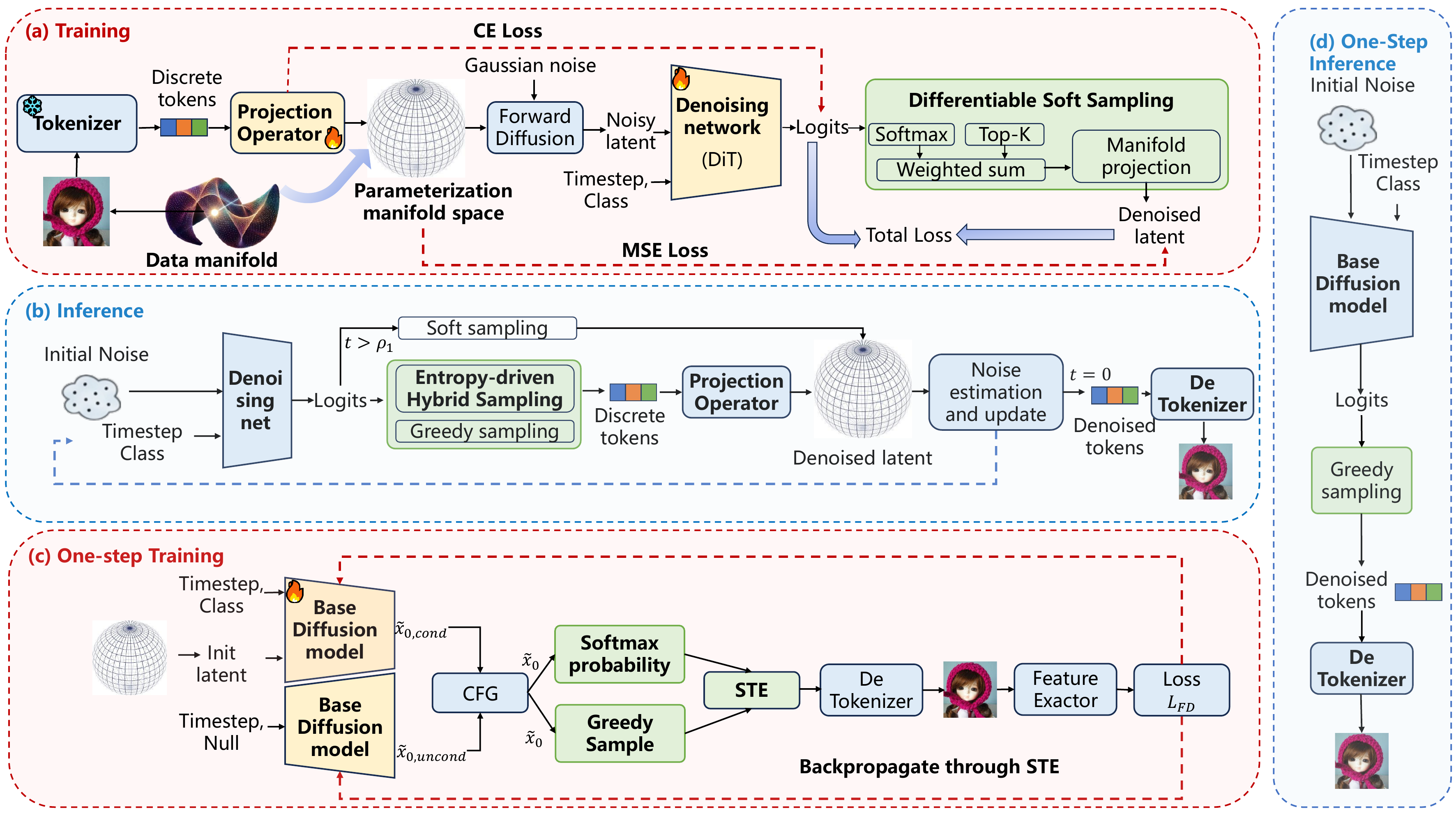
Discrete tokens are projected into a continuous parameterized manifold. Forward diffusion produces noisy latents; a DiT predicts logits that are supervised through CE and manifold-space MSE losses.
Sampling changes with timestep: differentiable soft sampling, entropy-driven hybrid sampling, and greedy projection guide the latent toward valid discrete tokens before decoding.
Conditional and unconditional predictions are combined by CFG. A greedy straight-through estimator preserves gradients through token selection and the decoder to optimize the FD loss.
The distilled model maps initial noise to token logits in one network evaluation. Greedy sampling and the tokenizer decoder directly produce the final image.
MIND inserts manifold-aware structure where a continuous diffusion transformer needs it most—inside the score function itself.
Structural anchors form a compact parameterization of the image manifold.
A differentiable bridge lets discrete assignments learn end-to-end.
Dual branches recover detail that low-dimensional transformer inputs can miss.
The sampler changes strategy across time as topology turns into texture.
Five images generated by MIND-XL-G. Every frame decodes the token prediction recorded at that exact step.
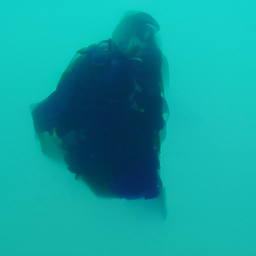
The high-quality sampler is unchanged. During the first 25 soft steps, argmax tokens are decoded only for visualization; from step 26 onward, the frames show the tokens selected by the original sampling logic.
One network evaluation maps a 16 × 16 × 16 continuous latent-noise state to image-token logits, followed by a single tokenizer decode.
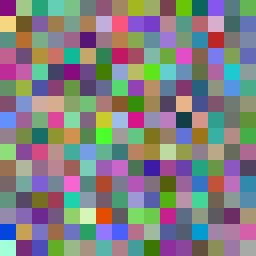
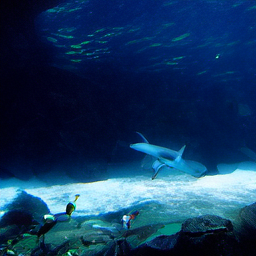
The input is an exact three-channel projection of the CUDA latent noise used for each selected result—not simulated image-space noise. The brief transition denotes one model evaluation; no intermediate denoising steps are implied.
One-step FD distillation prioritizes speed; multi-step MIND-XL-G achieves stronger distributional fidelity on ImageNet 256 × 256.
MIND-XL-G · 715M parameters
FD-distilled MIND · 600M parameters
FID and FDr⁶: lower is better.
Conclusion